

Art is Serious Play.
What does it take to create a truly beautiful work of art? Is it vision, mastery, purpose, love, or play? Or is it the alchemy of all five? Jimmy and the Demons, directed by Cindy Meryl, explores these questions in a special screening at Park Slope’s Nighthawk Cinema. The documentary reveals a simple but profound idea: the greatest art is serious play.
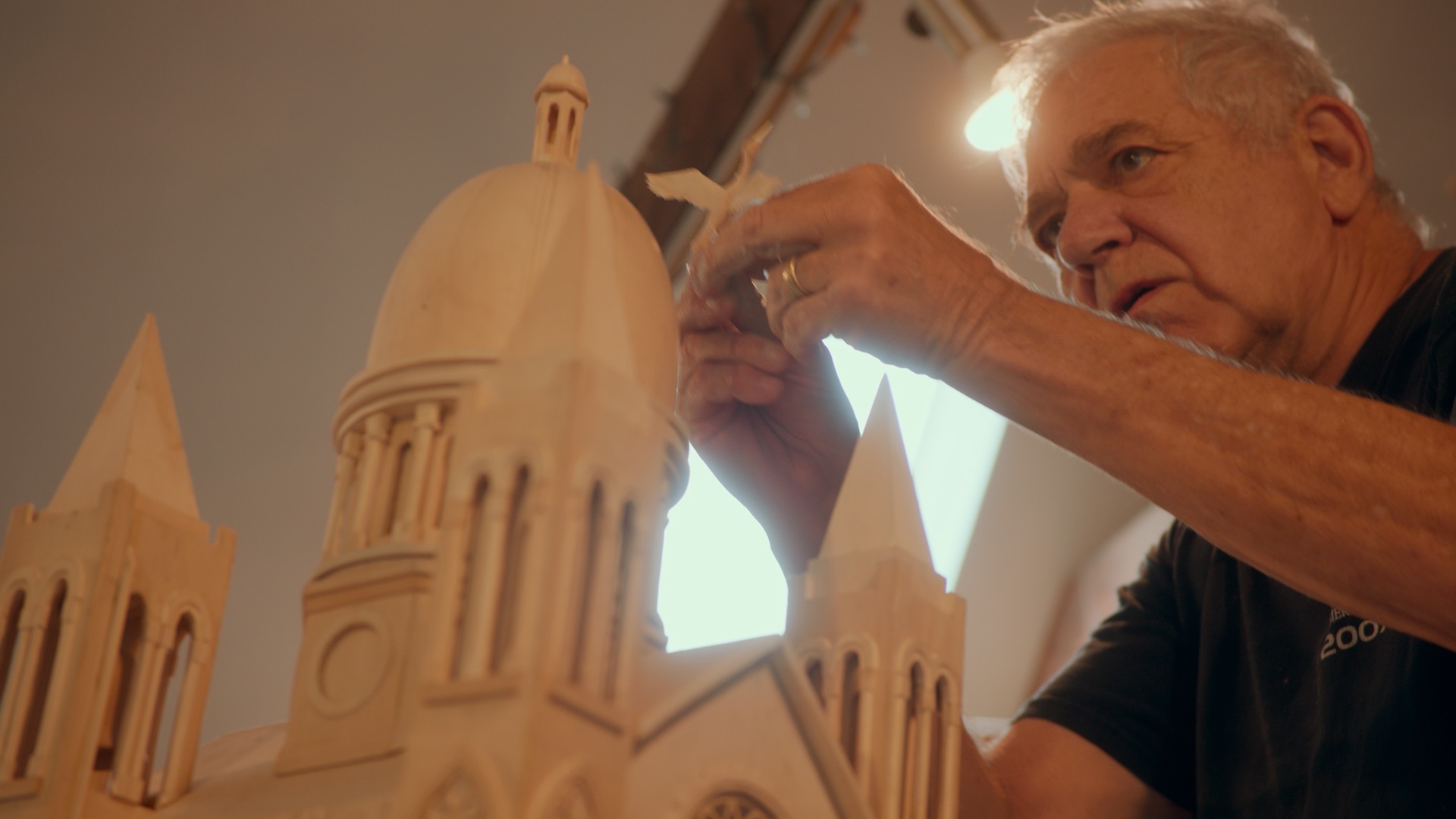
at work on his magnum opus.
The film opens with artist Jim Grashow at work on his magnum opus—his grand finale. Commissioned by collector Michael Marocco, a devout Catholic who gives him complete creative freedom, Jim chooses to carve a cathedral. The decision is rooted in both reverence and risk. Faced with Marocco’s deep faith, Jim feels the weight of honoring the story of Jesus.
That pressure becomes one of the film’s central threads. Jim is navigating not just artistic ambition, but the limits of his own body and time. His wife, Guzzy, explains that he is on blood thinners after suffering an embolism. Even so, he continues the painstaking work of carving intricate figures and details. At one point, he wonders aloud whether he will live long enough to finish the piece.
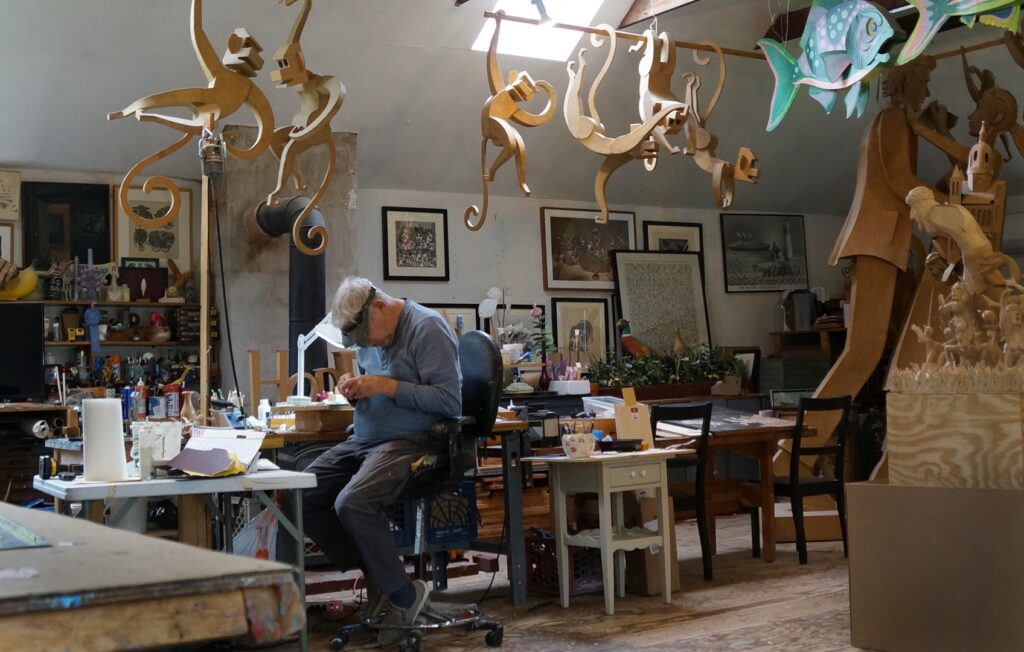
art is serious play.
Yet it’s amidst this tension that the film’s core insight emerges. Jim discovers that art is serious play. At one point Jim declares “the engine of creativity is play. Everyone learns not to play as they get older, but an artist knows how to play. I am older, but I am still playing.” The statement reframes the struggle not as burden alone, but as part of a deeper, almost childlike engagement with creation.
The film also captures Jim’s warmth and humor. At his birthday celebration, he sings to Guzzy with gentle affection, “I love you more than yesterday, but not as much as tomorrow”, a line from a 1969 Spiral Staircase song. This interaction underscores the tenderness woven throughout his life and work.
Perils and demons.
Jim is playful, but he also has a dark side that has been present since childhood. His life is marked by struggle when he develops dyslexia. His academic career suffered as a consequence, which led to a crushing sense of inadequacy. It’s at this time that he learns about the history of Jewish persecution in Europe. He confides that all of this left him feeling as if he were “dust in the wind.” It’s also at this time, however, that he discovers that art is his true calling. Jim reflects on this turbulent period of his life, saying “the world is full of perils and demons.”
A vision emerges.
After much deliberation, Jim arrives on a vision for his cathedral: Jesus bearing the cathedral on his back, carrying the sins of the world so that others may be redeemed. Though he strains under the immense weight, his face remains serene— an image of suffering tempered by grace. At Jesus’ feet are flames with tortured faces, grotesque, writhing demons, and angels. In one darkly humorous moment Jim is carving a demon and confesses “I have always wanted to carve demon nipples.
Above this tormented foundation exists an entirely different realm. The cathedral rises as a world of harmony and beauty. Strong walls enclose a space of warmth and light. Stained glass panels displaying biblical stories, such as the story of Genesis, decorate the fortified walls, while statues of Catholic saints stand on guard outside. Gargoyles perch on steeples, watching silently. At the summit, a dome is crowned by a single, elegant bird—delicate, almost transcendent.
The interior reveals an even more intimate layer: when a wall is lifted, a miniature figure of Michael Marocco can be seen in prayer, inhabiting this sacred space.
The sculpture is equal parts horror and hope. The brutal world below is juxtaposed to the ethereal realm above. Humor, sadness, horror, beauty, life, mortality, and eternity all intertwine and coexist within the art without diminishing one another, just as they do in life itself.
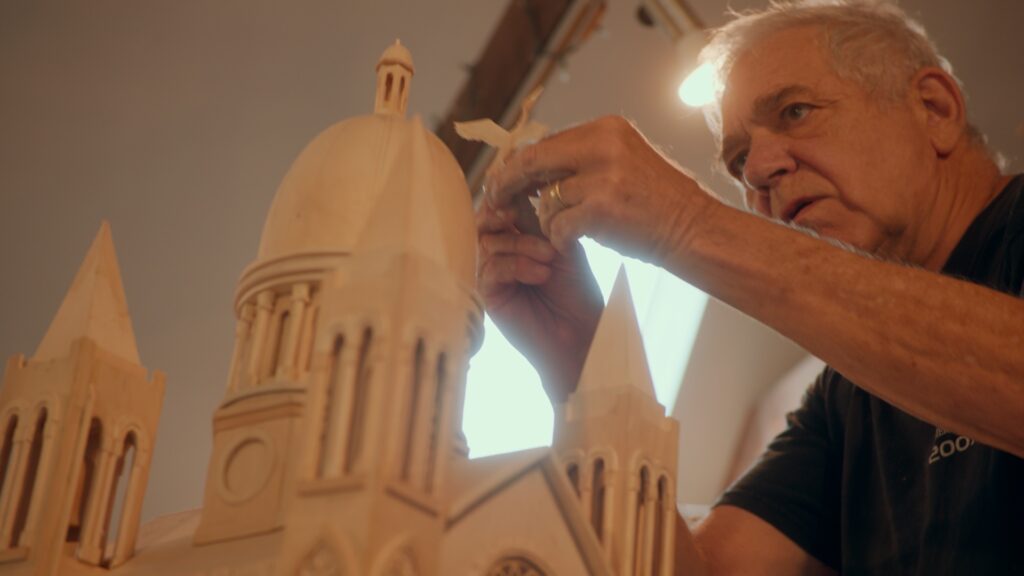
Great art is serious play.
Through his art Jim reaches toward something enduring. He taps into his deepest emotions, using art as a means to confront—and perhaps outrun—his demons. Though he is not Catholic, this cathedral carries a solemn weight as his final artistic statement. The completion of this cathedral will be bittersweet. “I am in the bottom of the ninth,” he reflects. “What do you say after you have said everything you could say?”
Jim and the Demons is a visual and emotional feast, balancing darkness with humor and grace. It’s as philosophical as it is a warm, cozy hug. It suggests that great art does not come from perfection, but from engagement—from the willingness to play seriously with life’s heaviest truths. It leaves us with a question: what raw materials in our own lives are waiting for us to transform them?
James Grashow was born January 16, 1942 to a Jewish family in Brooklyn. Over a decades-long career, he worked across illustration and sculpture, in multiple mediums. His art was regularly featured in the New York Times for 30 years, along with publications in Rolling Stone magazine, among others. He passed away on September 15, 2025—but not before completing his cathedral and seeing this documentary brought to life.
Jimmy and the Demons tour.
After the screening a Q&A was held with Guzzy Grashow and their son. Loyal fans requested Guzzy to share about cherished memories, such as the humorous “secret monkeys” story. She explained that once she was frustrated with how much time Jim was working on a project, so he covertly made monkeys off the clock. Jimmy and the Demons is currently on tour in California and then Columbus, Ohio.
Read more about James Grashow:
https://en.wikipedia.org/wiki/James_Grashow
Read about James Grashow’s Corrugated Fountain art installation:
https://thealdrich.org/exhibitions/james-grashow-corrugated-fountain
As always I, and the team at Brooklynites.NYC, thank you for reading.
Read a review of Howard Bloom’s latest book the Case for the Sexual Cosmos:
https://brooklynites.nyc/the-case-for-the-sexual-cosmos/
No casino in Coney Island: